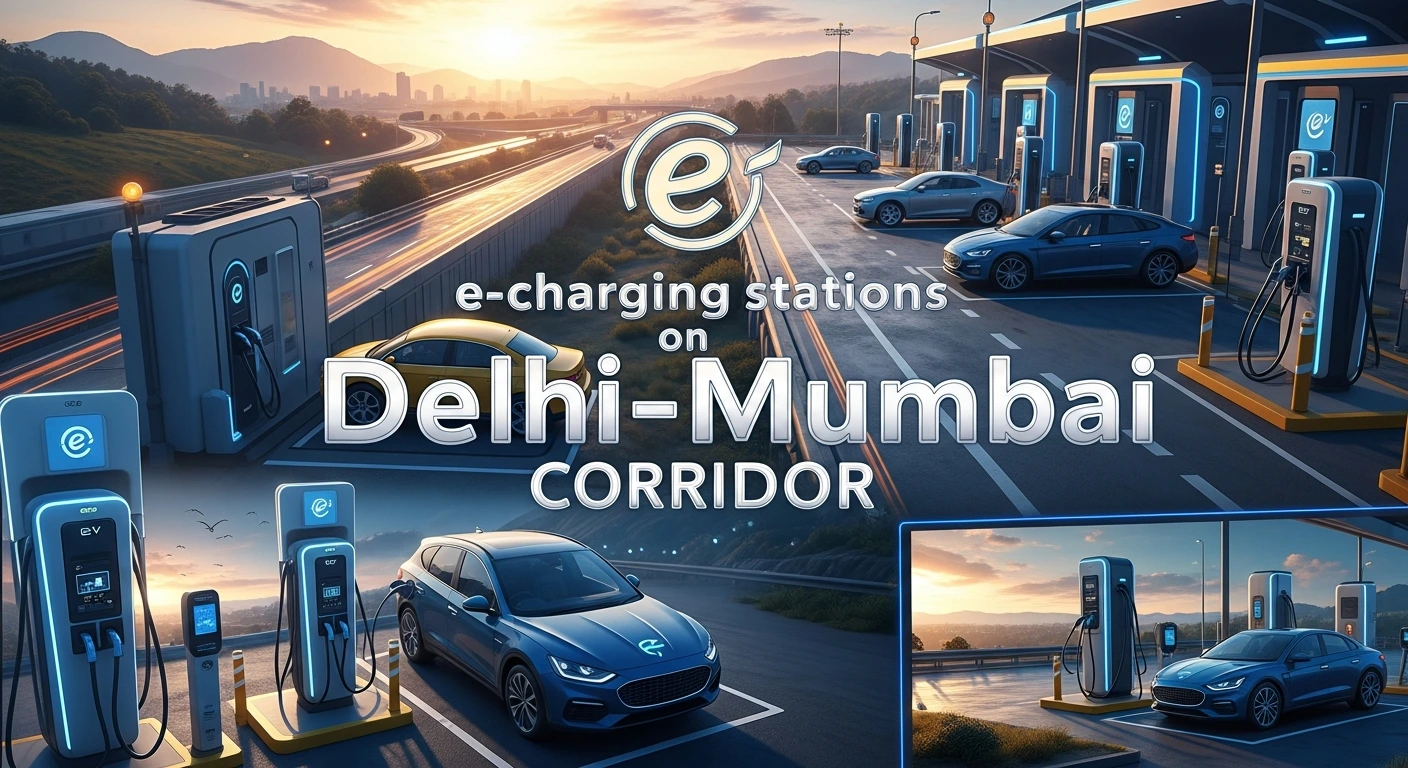
The Delhi-Mumbai Expressway (DME), a flagship project of the National Highways Authority of India (NHAI), is being developed as a major “Green Corridor“, and a critical component of this initiative is the extensive provision of Electric Vehicle (EV) charging infrastructure. This transformation is set to significantly boost long-distance EV travel confidence.
Current and Planned Infrastructure Status (Target 2025)
The primary goal is to ensure a seamless and anxiety-free journey for EV users across the entire 1,350 km corridor.
- Rollout Timeline: While sections of the expressway are already operational, the comprehensive rollout of EV charging stations along the full stretch is anticipated to be complete by August 2025.
- Spacing and Coverage: Charging stations are planned to be spaced approximately 40 to 60 kilometers apart. This ensures that most EVs, even those with smaller battery packs, can complete the journey without significant “range anxiety.”
- Wayside Amenities (WSAs): Over 93 Wayside Amenities are being developed along the corridor, and most are planned to include fast-charging infrastructure alongside essential amenities like restaurants, restrooms, and emergency services.
Types of Chargers & Operators
The infrastructure is designed to cater to all major EV formats, including two-wheelers, passenger cars, and commercial vehicles.
| Charger Type | Description | Use Case on Expressway |
| DC Fast Chargers | High-capacity chargers (50 kW to 350 kW) with connectors like CCS2 and CHAdeMO. | Primary choice for intercity travel, allowing a fast top-up (typically 20-80% charge in under an hour). |
| AC Chargers | Slower chargers (typically up to 22 kW). | May be available at some rest points for overnight or longer stops. |
| Battery Swapping Facilities | Stations where a depleted battery can be quickly exchanged for a fully charged one. | Planned for select locations, catering specifically to commercial or last-mile vehicles. |
Key Charging Point Operators (CPOs) like Tata Power (EZ Charge), ChargeZone, Statiq, and IOCL are actively involved in the development and operation of these charging hubs through Public-Private Partnerships (PPPs).
Technology and User Experience
The new infrastructure leverages smart technology to enhance the EV driving experience:
- Real-Time Monitoring: Mobile applications offered by CPOs provide real-time updates on charger availability, pricing, and operational status.
- Digital Payments: Stations accept digital payment options, and some operators offer RFID cards for hassle-free tap-and-charge functionality.
- Integration with Policy: The development is aligned with central government schemes like FAME II and the broader goal of building Electric Highways (e-highways) to accelerate EV adoption.
Actionable Resources for EV Drivers
As the expressway and its amenities become fully operational, EV drivers should use these resources for trip planning:
- CPO Mobile Apps: Tata Power EZ Charge, Statiq, ChargeZone, and Jio BP Pulse apps are essential for locating, booking, and managing charging sessions.
- Community-Driven Maps: Platforms like PlugShare often have the most up-to-date, user-verified locations and reviews, which are invaluable on long-distance routes.
- Government Portals: The Ministry of Road Transport and Highways (MoRTH) and NHAI websites may publish official lists of operational charging sites at Wayside Amenities (WSAs).
The integration of e-charging facilities into the Delhi-Mumbai Expressway is a monumental step, turning what was once a long-distance challenge into a reality for electric vehicle owners.